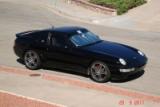
yeah, nice idea twin turbos, but for a four banger, not really necessary. and ther is not much room to work with.
TURBO:
I plan to run for the most part in the 3500-7000 rpm range and I will build the turbo accordingly. Speaking of which, Nick and I discussed the turbo build some more today. My original T3 .48 a/rhousing is great for 2.0-2.5L flow rates with 16v head. Obviously, our engines are not this size. And since I am not destroking the engine and keeping the original volume at 3.0L, I decided to move up to a .63 T3 turbine housing. This will allow more flow and create less backpressure but still be able to drive the turbine wheel effeciently. With our engine, this will allow power capability of at least 400hp. However, I don't intend on going that high. On the other hand, I will lose some low end boost and will have to get by on the 8.5:1 comp ration. Since I plan to shift like I do now, in the 4-6000 range, I am going with a turbo that is 'on-boost' at this rpm range or higher. Nick is also checking compressor and turbine deck height to make sure the wheels are centered on the air flow.
We also increased the size of the compressor side. remember, turbos are like a figure eight circuit with two open ends. what you do on one side affects the other side. What is nice about the T3 style of turbines is the interchangeability. You can find any size you need in the housing and the wheel. But I think they stopped making them recently. not sure...
Generally , the smaller the a/r turbine, the more high speed exhaust is directed on to the turbine wheel which causes it to spool faster (with a give volume of exhaust). You would not put a .48 a/r T3 on a v8 mustang as a single turbo, but you could use two in a twin turbo setup. You have to find a balance.
The volumetric efficiency of the 16v head with stock valves is excellent (as we all know). So this will make a great turbo head as well. I am not going over 2 point of boost ever, so this head should be fine with stock cams and timing as discussed above. Intercooler (which has not arrived yet) and lower compression will allow more boost than without these advantages, and risk of detonation is decreased. More boost= more power. BIG thing is to keep intake and especially exhaust heat down.
My center cartridge is oil and water cooled. helps to extend turbo bearing life. hopefully, in a week or two, I will have some turbo pics....
FLYWHEEL:
flywheel arrived. It is perfect but just needs contact surface work. Nice thing about the S2 flywheel is:
1) fits housing and crank
2) weighs ~16 lbs, faster spin up means faster 'on-boost'
3) has timing marks (unlike the 944 turbo or NA engine) so that I can use stock 968 fly sensors with the haltech
4) although it has a slightly smaller radius than the turbo fly (and hence less contact area), Centerforce makes a dual friction pressure plate and disc for 479$. that makes it way cheaper than 944 turbo or 968 centerforce setups. The centerforce disc and pp will be more than enough for my build.
5) Ring gear is the only major clutch issue. I was able to buy an S2 pp W/ring gear in excellent for 25$ (ring gear from dealer or pelican is 400$). I just have to heat it and press it off ..then heat it and press it on the new pp...not a big deal) ring gear is held in place partly with 9 bolts as well, so I am not too worried about removing and replacing
6) everything fits in standard 944 S2 housing which then allows more room for exhaust pipes
So for all the above reasons, I have chosen to go with the S2 clutch approach. Unfortunately, you have to find all the parts to make it work.